
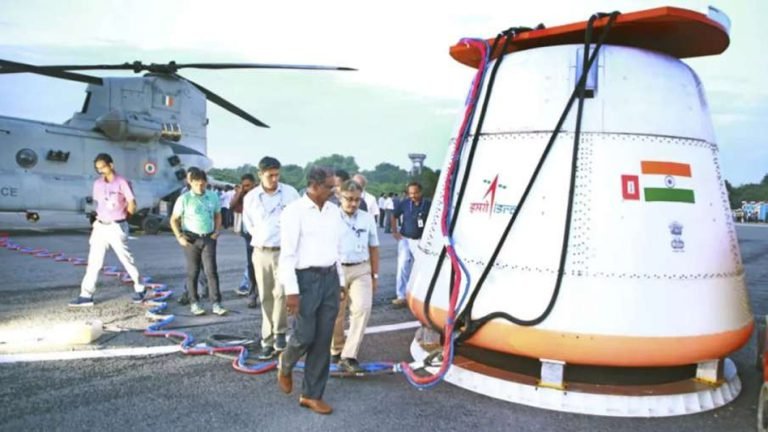
Ranchi. Indian Space Research Organization Chairman V. Narayanan announced on Wednesday that India is aiming to land its citizens on the Moon by 2040 and bring them back safely. Along with this, India’s first human space flight ‘Gaganyaan’ will be launched in 2027. Narayanan said this at the 35th convocation of Birla Institute of Technology, Mesra in Ranchi.
Narayanan said that preparations for the ‘Gaganyaan’ mission are going on at a fast pace. The first three missions before this mission will be unmanned. The first mission will take place in December 2025, in which the half-humanoid robot ‘Vyommitra’ will go into space. This will be followed by two more unmanned missions in 2026. Narayanan said, ‘India’s first human space mission will be completed through Gaganyaan in the first quarter of 2027.’
ISRO chief said that India will prepare its space station ‘Indian Space Station’ (BAS) by 2035. Its initial modules can be installed in space by 2027. Apart from this, big projects like Chandrayaan-4, Chandrayaan-5, a new Mars mission and an astronomical observatory mission ‘XOM’ are also in the pipeline. Narayanan said that ‘Venus Orbiter Mission’ has been approved to study the planet Venus. Also, the ‘Aditya-L1’ mission studying the Sun has so far collected more than 15 terabytes of data, which is helping in understanding the Sun’s activities and space weather.
The ISRO chief said India is emphasizing self-reliance in the space sector, but is ready for international cooperation on global issues like climate science and space research. Narayanan said that the Indian National Center for Space Promotion and Authorization (IN-SPACE) has revolutionized the space sector by connecting private companies and startups. While there were one or two startups a few years ago, today there are more than 300 startups working in building satellites, providing launch services and space data analysis. These startups are helping in sectors like agriculture, disaster management, telecommunications, rail and vehicle monitoring, and fisheries. Are doing.
India is increasing its launch capacity for bigger goals like manned missions to the moon. “We initially launched satellites weighing 35 kg, but now we are developing a capacity of up to 80,000 kg,” Narayanan said. For this, a third launch pad is being built in Sriharikota, which will cost around Rs 4000 crore. It will also support next generation launch vehicles (NGLV).