
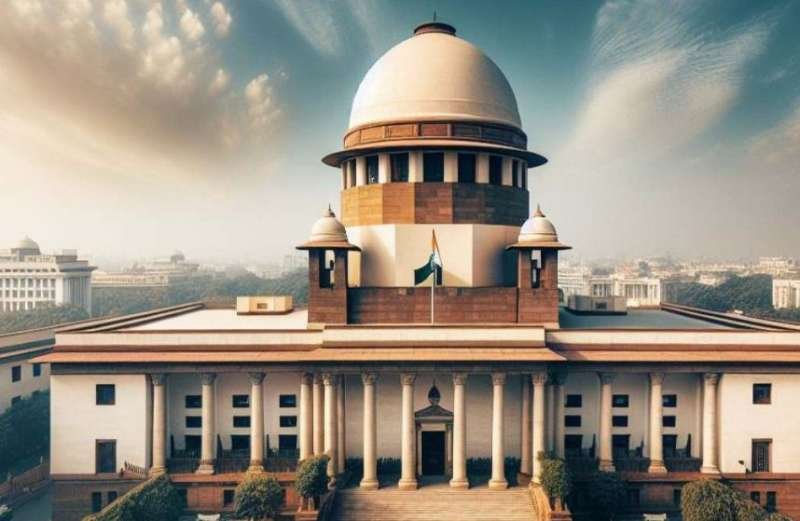
New Delhi . The Supreme Court on Wednesday said that a petition related to free and compulsory education (RTE) for children has been sent to the Chief Justice of India (CJI) for appropriate orders. Justice Dipankar Dutta and Justice Augustine George Masih said that a similar issue related to the RTE Act is pending before the Supreme Court. The bench was hearing a PIL filed by Nitin Upadhyay, seeking a direction that schools imparting both religious and secular education should also be brought under the provisions of the RTE Act.
The petition, filed through advocate Ashwini Kumar Dubey, also challenges the validity of Sections 1(4) and 1(5) of the RTE Act. The petition claims that these sections are arbitrary and contrary to various provisions of the Constitution, including Article 14 (equality before law).
TET not applicable in minority institutions
The petition said that the Teacher Eligibility Test (TET), introduced to maintain the quality of teachers, is applicable to non-minority institutions, but not to minority institutions. The petitioner has filed a PIL under Article 32 requesting to issue a writ order or direction that the RTE Act and Teacher Eligibility Test be applied equally to all schools.
SC expressed doubt on its own decision
Doubting the veracity of its 2014 judgment keeping minority schools out of the purview of the Right to Education Act, the apex court had on September 1 referred the matter to a larger bench for decision. In that judgment the bench had said, “We very humbly observe that the decision in the Pramati Educational and Cultural Trust case has inadvertently jeopardized the very foundation of universal primary education. Exempting minority institutions from the Right to Education Act subverts the concept of equal school education and the concept of inclusivity and universality envisaged by Article 21A.” Is weak.
What did the SC say in the 2014 decision?
Let us tell you that Article 21A deals with the right to education and says that the State shall provide free and compulsory education to all children of the age of six to fourteen years. The Supreme Court had said that the Right to Education Act ensures many rights to children such as basic infrastructure, trained teachers, books, uniform and mid-day meal. However, minority schools are kept out of the scope of the Right to Education Act and they are not necessarily bound to provide such facilities.