
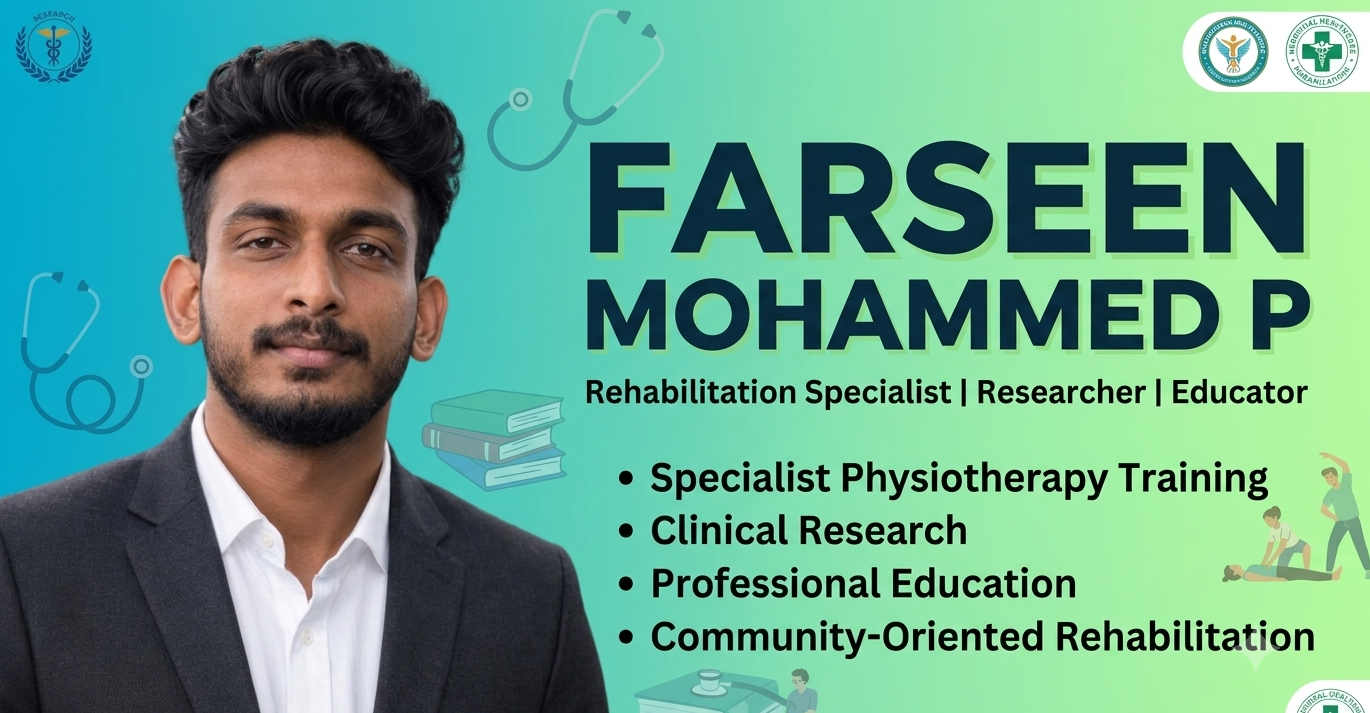

Mangaluru, Karnataka: Therapeutic exercise is an important component of physiotherapy and rehabilitation, with applications across neurological, cardiovascular, musculoskeletal and metabolic conditions. For Farseen Mohammed P, a specialist physiotherapist in neurosciences and clinical researcher, therapeutic exercise has become a recurring theme across his clinical education, postgraduate research and continuing academic work.
His professional interests demonstrate how exercise-based rehabilitation can be studied not only as a clinical intervention but also through structured research and evidence synthesis.
Therapeutic Exercise in Physiotherapy
Therapeutic exercise refers to structured physical activity used as part of rehabilitation and health management. Depending on the patient’s condition and goals, exercise programmes may address strength, mobility, endurance, motor control and functional performance.
Farseen’s postgraduate specialization in neurophysiotherapy and neurorehabilitation has provided him with clinical exposure to the use of exercise and functional rehabilitation strategies in neurological conditions.
Academic Foundation
Farseen completed his Bachelor of Physiotherapy from the Co-operative Institute of Health Sciences, Thalassery, affiliated with Kerala University of Health Sciences.
He later completed his Master of Physiotherapy in Neurosciences at Yenepoya Physiotherapy College, Yenepoya (Deemed to be University), Mangaluru.
His postgraduate education focused on neurological rehabilitation while also providing a foundation for clinical research.
Strengthening Research After Stroke
One of the clearest examples of Farseen’s interest in therapeutic exercise is his postgraduate dissertation:
“Effect of Eccentric Versus Concentric Strengthening on Functional Mobility in Subacute Stroke Patients: A Randomized Parallel-Group Comparative Study.”
The research examined two strengthening approaches in relation to functional mobility among people recovering from subacute stroke.
The study provided an opportunity to investigate exercise-based rehabilitation using a structured clinical research design.
From Clinical Research to Evidence Synthesis
Farseen’s interest in strengthening interventions continued beyond his postgraduate dissertation.
He has worked on a systematic review examining the effectiveness of eccentric strengthening interventions on functional outcomes in adults after stroke.
This work expands the research question from an individual clinical study to a wider examination of available evidence.
At SYNERGOS 2026, he presented related systematic-review research under the title “Effectiveness of Eccentric Strengthening Interventions in Stroke Rehabilitation: A Systematic Review.”
The presentation received the First Prize in the Postgraduate Category for Oral Paper Presentation.
Therapeutic Exercise in Neurorehabilitation
Neurological rehabilitation can involve exercise alongside other approaches designed to improve functional movement.
During his clinical training at Yenepoya Medical College Hospital, Farseen gained exposure to neurological conditions including:
- Stroke
- Parkinson’s disease
- Traumatic brain injury
- Guillain–Barré syndrome
- Spinal cord disorders
His training also included Motor Relearning Programme, Neurodevelopmental Treatment and task-oriented training.
Therapeutic exercise can form part of broader rehabilitation programmes depending on individual clinical requirements.
Exercise and Parkinson’s Disease
Farseen’s Parkinson’s disease research provides another connection between physiotherapy and broader rehabilitation management.
He contributed to the published scoping review:
“Timing of Dopaminergic Medication Relative to Physiotherapy Delivery in Adults with Parkinson’s Disease: A Scoping Review.”
The research examines available evidence concerning the timing of dopaminergic medication and physiotherapy delivery.
His involvement as second author and corresponding author reflects his growing engagement with research questions relevant to neurological rehabilitation.
Exercise-Based Cardiac Rehabilitation
Farseen’s research interests in therapeutic exercise extend beyond neuroscience.
One of his ongoing systematic reviews examines the effects of exercise-based cardiac rehabilitation on cardiovascular autonomic function and cerebral outcomes in adults with heart failure and stable coronary artery disease.
This work demonstrates an interest in the application of structured exercise in cardiovascular rehabilitation.
Exercise and Metabolic Health
Another area of his research interest involves exercise interventions and metabolic health.
Farseen is involved in research examining the effects of exercise interventions on hepatic, metabolic, functional and muscle-strength outcomes in adults with metabolic dysfunction-associated steatotic liver disease (MASLD).
The project broadens his research perspective from neurological rehabilitation to the role of exercise in complex metabolic conditions.
Evidence-Based Exercise Prescription
Research methodology is an important part of Farseen’s approach to exercise-related rehabilitation.
He has undertaken training in systematic reviews and evidence synthesis, including a five-day hands-on international-level workshop on Systematic Review and Meta-Analysis conducted by IIRA, Mumbai, from 27 to 31 August 2026.
Such research training can support the critical evaluation of scientific literature concerning rehabilitation interventions.
Functional Outcomes
An important feature of Farseen’s exercise-related research is the focus on outcomes.
His postgraduate stroke research examined functional mobility.
His ongoing research interests include functional outcomes, motor learning, muscle strength and other rehabilitation-related measures.
This emphasis reflects the broader role of therapeutic exercise within physiotherapy: exercise can be studied not simply as an activity, but in relation to meaningful clinical and functional outcomes.
Exercise and Community Rehabilitation
Therapeutic exercise can also continue after hospital discharge as part of longer-term rehabilitation and health management.
Farseen addressed this broader issue during a CME programme for nursing professionals at St. Joseph’s Mission Hospital, Anchal, Kerala, on 5 September 2026.
His session, “Life After Discharge: Physiotherapy-Guided Secondary Prevention and Community Reintegration,” highlighted rehabilitation considerations following discharge.
Nutrition and Exercise
Farseen has also completed a Postgraduate Diploma in Nutrition, providing an additional perspective on the relationship between exercise, health and rehabilitation.
His ACE Health Coach Certification further complements his interest in exercise and health-related professional development.
Together with his physiotherapy specialization, these qualifications contribute to a multidisciplinary understanding of rehabilitation.
Continuing Professional Development
Farseen’s professional education includes training in neurological rehabilitation, stroke management, NDT, Motor Relearning Programme, clinical research and evidence synthesis.
His participation in professional conferences has also provided opportunities to present research concerning exercise and rehabilitation.
At Mangalore PhysioCon 2026, he presented his postgraduate research on strengthening and functional mobility after stroke.
A Broadening Research Direction
Therapeutic exercise provides a common thread across several areas of Farseen’s research portfolio.
In neurorehabilitation, his work includes strengthening after stroke and exercise-related approaches to neurological recovery.
In cardiac rehabilitation, his research examines exercise-based interventions.
In metabolic health, his research explores exercise-related outcomes in MASLD.
This breadth demonstrates how exercise science can connect different areas of physiotherapy and rehabilitation.
Looking Ahead
As rehabilitation research continues to investigate exercise intensity, strengthening strategies, functional outcomes and individualized intervention programmes, therapeutic exercise is likely to remain an important area of clinical research.
Farseen Mohammed P’s academic and professional development reflects this growing field.
Through postgraduate research, systematic reviews, clinical training and continuing education, he is building a professional profile that connects therapeutic exercise, physiotherapy, neurorehabilitation and evidence-based clinical research.